

From wood waste to furniture – ABB and Stena Recycling in innovative collaboration
Increasing recycling Rates to 90 Percent
Stena Recycling and ABB are now taking wood recycling to a new level. In a new collaboration where wood waste is transformed into raw material for furniture production, ABB Robotics increases its material recycling rate from 36 to a remarkable 90 percent. The partnership is an important step toward a more circular economy and reduced carbon emissions.
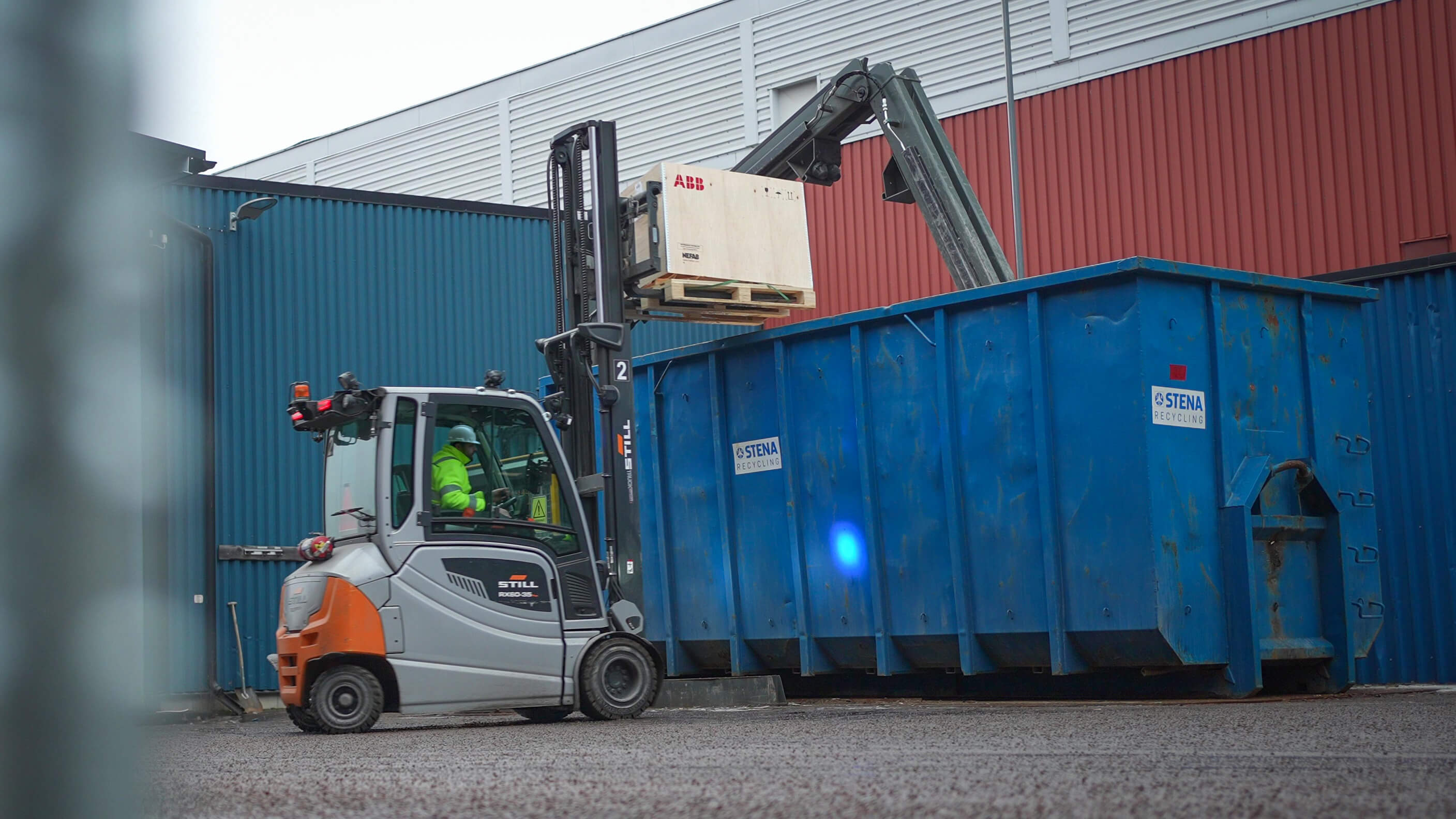
Every year, ABB Robotics generates approximately 1,300 tons of wood waste, primarily from single-use pallets used in transportation. Previously, this material was sent for energy recovery to produce district heating and electricity, but with the new solution, it gets a new life as particleboard for the furniture industry – a significantly more sustainable alternative.
Learn how the wood recycling process works:
Thorough quality assurance and sorting
The pallets are collected by Stena Recycling and transported from ABB in Västerås to the recycling facility in Eskilstuna. There, the material undergoes careful quality assurance and sorting before being processed and chipped with a wood chipping machine. The chipped wood is then transported to a large manufacturer in the furniture industry, which uses it to produce particleboard that becomes new furniture. In this way, the material gets an extended life and helps conserve the planet’s resources.
During the process, laboratory analyses by an external party are continuously conducted to ensure that the wood waste meets quality standards. These analyses include checking for metal content and the presence of substances classified as hazardous waste.
Promoting a Low-Carbon Society
Several other divisions and factories within ABB have joined the initiative. Stena Recycling now collects wood waste from multiple ABB factories in Sweden.
-We are pleased to be able to collaborate with Stena Recycling on this project. It is an important part of ABB’s sustainability strategy and our goals to reduce environmental impact, increase the recycling of our resources, and promote a low-carbon society. By working together, we can make significant progress toward a more sustainable future, says Ingrid Sefastsson, Head of Sustainability at ABB Sweden.
In this process, the wood waste is recycled instead of being used for energy recovery – a more environmentally advantageous solution. The material is utilized over a longer period, which increases resource efficiency and reduces the need for new raw materials.
-Our collaboration is an excellent example of how we can work together to create a more circular economy, and the solution demonstrates the innovative opportunities that exist within sustainable recycling. By recycling wood waste and transforming it into new products, we contribute to a more sustainable future, says Filip Lovemalm, Key Account Manager at Stena Recycling.


Matilda Börlin, Business Area Specialist at Stena Recycling, adds:
“We see a positive environmental saving in the form of reduced carbon emissions, fully in line with a more sustainable future. Going forward, we see continued opportunities to further develop the recycling of returned wood and other waste streams together with ABB.”


About ABB Robotics
ABB Robotics is one of the world’s leading suppliers of robotics and machine automation. As the oldest robot supplier, ABB Robotics has been providing industrial robots since the 1970s to facilitate automation in industry. ABB Robotics employs approximately 11,000 people across more than 100 locations in over 50 countries.


